
The Future-Ready Lab: Where People and Processes Evolve Together

What if the lab of the future isn't just about faster robots and smarter AI? It's about empowering the people behind the science. In the past decade, life sciences has transformed more dramatically than perhaps any other scientific sector. Technologies like automation, AI, multi-omics, and cloud-based platforms have redefined the pace of discovery. Yet amid all this innovation, one truth remains: a lab is only as future-ready as its people and its processes.
At IntellAstra Solutions, we believe the most successful organizations of tomorrow will be those that build labs designed not only for science — but for scalability, adaptability, and human growth.
The Lab Has Changed — And So Have Expectations
A generation ago, laboratories were built around predictable workflows: assays, sample prep, sequencing, analysis. Today, those boundaries are blurred. Automation platforms handle tasks once performed by graduate students and postdocs, AI algorithms drive decision-making, and distributed R&D networks mean research rarely happens under one roof.
According to recent analysis from McKinsey, a vast majority of life science companies are re-architecting their R&D workflows to integrate automation and analytics. Yet, these efforts are often hampered by a significant gap in human capability, with less than a third of leaders believing their workforce is fully prepared to leverage these new tools effectively.
This gap — between technological capacity and human capability — is the heart of the future-ready lab challenge.
Future-Ready = Process Excellence + People Empowerment
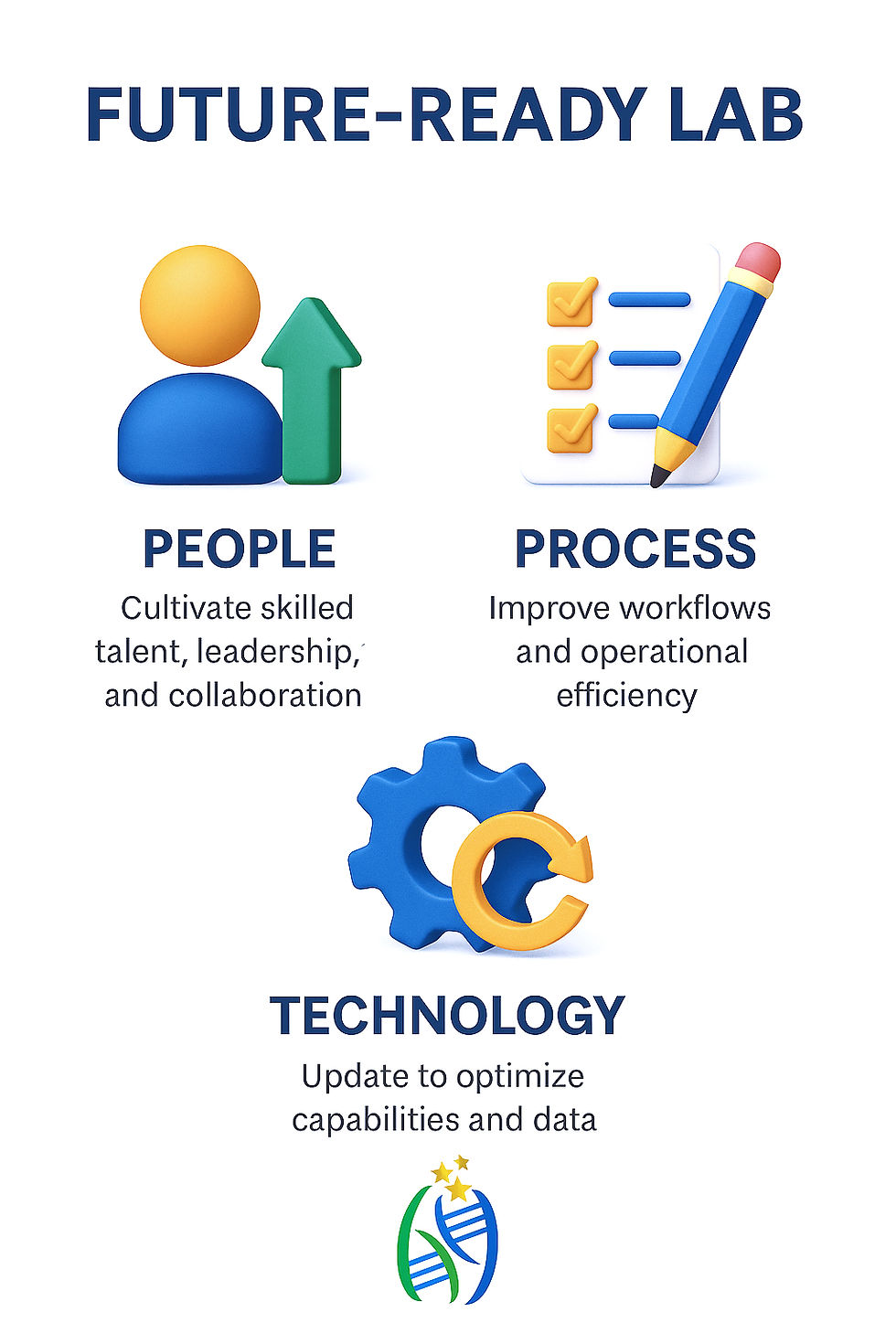
A “future-ready” lab isn’t just defined by its robotic platforms or digital dashboards. It’s an ecosystem — one where technology, process, and talent evolve in harmony.
1. Process: Building Systems That Scale
Operational efficiency is no longer a “nice-to-have.” It’s the foundation of competitive advantage.
Streamlined workflows reduce downtime and accelerate project timelines.
Digital traceability improves compliance and reduces costly errors.
Scalable systems ensure that capacity grows with demand, not against it.
A recent BCG analysis found that labs adopting Lean Six Sigma and automation together saw a 25–40% improvement in throughput — and a 30% reduction in operational cost per experiment.
2. People: Upskilling for the New Era
Even the most advanced infrastructure fails without people who know how to use it. The future lab workforce needs a new blend of skills — part scientist, part data interpreter, part systems thinker.
Automation doesn’t eliminate scientists — it amplifies their value by freeing them to focus on higher-impact work.
Data literacy and cross-disciplinary collaboration are becoming baseline expectations.
Continuous learning must be built into the culture, not treated as an optional extra.
Yet, more than 40% of scientists in mid- to late-career roles report difficulty adapting to new tools and workflows, according to BioProcess International. This is where strategic coaching and workforce development become mission-critical.
The New Lab Equation: Tech + Talent + Transformation
The next-generation lab is not just a place of science — it’s a strategic engine. It integrates automation with human insight, operational rigor with creative problem-solving. It’s agile enough to pivot when markets shift, and robust enough to scale when discoveries accelerate.
At IntellAstra Solutions, we work with organizations to bring this equation to life. Our approach combines:
Operational Strategy: Designing workflows, KPIs, and systems for scalability and speed.
Talent Development: Coaching teams to think strategically, collaborate effectively, and stay ahead of technological change.
Leadership Enablement: Equipping leaders to align talent, technology, and vision into a cohesive innovation strategy.
Evolving Together: The Human Side of Innovation
The future-ready lab isn’t just about what’s next in science — it’s about who’s next. And that means building environments where people grow with the science they drive.
A piece of automation might double your throughput, but a skilled, adaptive team will multiply your innovation. A smart LIMS platform might reduce errors, but a workforce that understands why and how to use it will prevent them altogether.
Technology builds capacity. People build possibility. And the organizations that master both will lead the next era of discovery.
The question isn’t “Is your lab equipped for the future?” — it’s “Are your people?”
At IntellAstra Solutions, we help life science organizations answer “yes” to both.


Comments